
Home, Undefined
Two readings of the same Palestine passport. Two histories. One unresolved question about home.

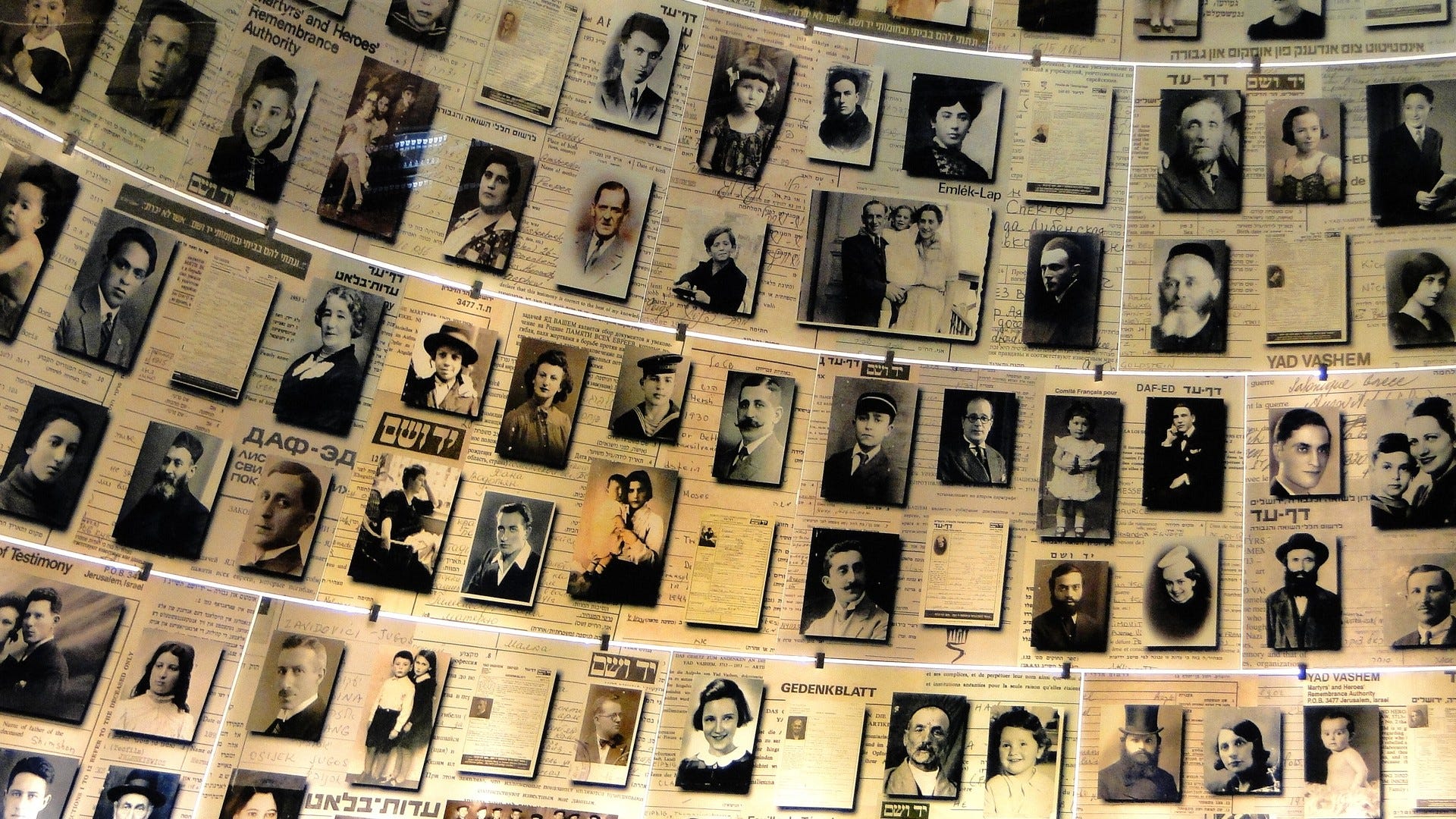
Hall of Names, Yad Vashem Holocaust History Museum, Jerusalem. Photo: Adam Jones, CC BY-SA 2.0, via Wikimedia Commons (cropped).
I.
In April 1903, in the Bessarabian city of Kishinev, a Christian boy is found stabbed in a nearby village. A regional newspaper, Bessarabetz, runs a blood-libel claim: Jews killed him for ritual purposes. The story is false. The investigation that follows the killing — when it comes — will identify the murderer as a Christian relative. None of that matters by Easter Sunday. A crowd of several thousand moves through the Jewish quarter for three days. The Russian Imperial police, under orders to maintain calm, maintain it by maintaining their position on the perimeter and watching. Forty-nine Jews are killed. Roughly 500 are injured. Approximately 1,500 houses and businesses are destroyed.
The poet Chaim Nahman Bialik travels to Kishinev a few weeks later to take testimony for the Jewish historical commission. He writes a poem called In the City of Slaughter, which becomes the founding document of modern Hebrew political consciousness. The poem does not say what is usually said about a pogrom. It does not weep for the victims. It rages at them — at the men who hid in cellars while their wives were raped, at a community that asked for pity instead of taking up arms. The lesson Bialik draws is not that the world is cruel. It is that the diaspora Jew, in his accumulated centuries of helplessness, has lost the capacity to resist. The new Jew, if there is to be one, will have to be invented somewhere else.
This is one of the moments where modern Zionism, which had been a small intellectual movement in Vienna and Basel and Odessa, becomes a mass political project. Theodor Herzl had argued in 1896 that the Jews of Europe had no future in Europe and needed a state. After Kishinev, large numbers of Eastern European Jews start to agree with him. The Second Aliyah — the second wave of immigration to Ottoman Palestine — brings approximately 35,000 Jews between 1904 and 1914. They come from the same villages that the pogroms came from. They come with a particular education. They have learned what a state apparatus will do to a minority when it decides not to protect them.
In 1922, the new British Mandate of Palestine conducts a census. The total population is 757,182. Of these, 590,890 are Muslims, 73,024 are Christians, and 83,794 are Jews. The Arab population is the majority of the land by a factor of nearly eight to one.
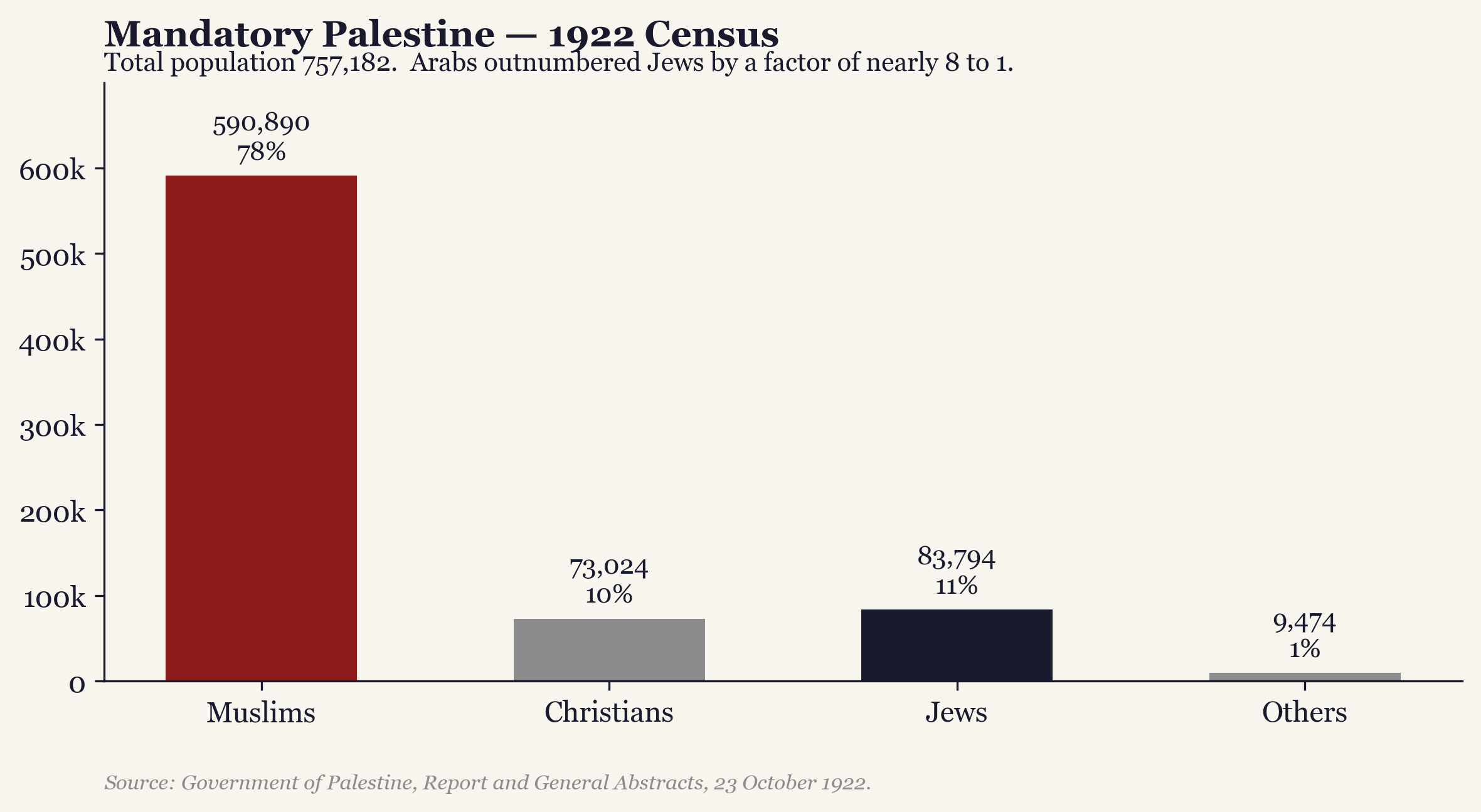
Mandatory Palestine — 1922 Census. Source: Government of Palestine, Report and General Abstracts of the Census of 1922.
In 1921, a Russian-born immigrant named Golda Mabowicz, who has just arrived in Tel Aviv from Milwaukee, registers for a passport issued by the British Mandate authorities. The document is called a Palestine passport. She carries it until the State of Israel is declared in 1948, at which point she changes her name to Golda Meir and joins the cabinet.
Forty-eight years later, as Prime Minister, she gives an interview to Thames Television. The interviewer asks about the Palestinians. “When were Palestinians born?” she says. “There was no such thing in this area as Jews, and Arabs, and Palestinians. There were Jews and Arabs. I am a Palestinian. From 1921 to 1948 I carried a Palestinian passport.”
The argument was meant as a denial. It was structurally a confirmation. If Golda Mabowicz of Kyiv could carry a passport that named her a Palestinian, so could the Muslims and Christians who had been there for centuries. The Mandate had stamped them all with the same identity. What Meir treated as proof that the Palestinians did not exist was actually proof that everyone in Mandatory Palestine was, by the document in their pocket, Palestinian.
The collision between those two readings of the same passport is the founding asymmetry of the conflict.
Between 1922 and 1939, three more waves of immigration follow. The Third Aliyah brings about 40,000 after the First World War. The Fourth and Fifth bring perhaps 300,000 more — most of them during the 1930s, as German and Austrian Jews try to leave a continent that is closing its doors. The 1924 Johnson-Reed Act has restricted American immigration severely. Britain restricts Palestinian immigration after the Arab Revolt of 1936-39. The numbers of people who want to leave Europe are large. The places willing to take them are few. The St. Louis sails out of Hamburg in May 1939 with 937 German Jewish refugees aboard. Cuba refuses to land them. The United States refuses to land them. Canada refuses to land them. They return to Antwerp. Of those who do not subsequently make it out of Western Europe, 254 will die in the camps.
By 1939, there is one place on earth that has organized itself politically around the proposition that no Jewish refugee will ever again be turned away. It is not yet a state. It is a project of approximately 450,000 people on a piece of land where the British have begun, under Arab political pressure, to limit further immigration. The trap is closing on both ends.
II.
The full architecture of what happens to European Jewry between 1939 and 1945 is in the Yad Vashem archive — page after page of names, of which the institution holds about 4.9 million. The number that did not return to those names is approximately six million.
What is sometimes obscured by the focus on Auschwitz as the central horror is the geographic spread of complicity. The Holocaust required collaborators in nearly every country it touched. The Slovak state under Father Jozef Tiso paid the German government 500 Reichsmarks for each Jew it deported — approximately 58,000 of them between March and October 1942 — in exchange for the right to keep their property. The Vichy regime’s French police rounded up 13,152 Jews in Paris on July 16 and 17, 1942, including 4,115 children, with families held at the Vélodrome d’Hiver before deportation. The Iași pogrom in Romania, June 28-30, 1941, killed 13,266 Jews in three days — carried out by Romanian soldiers, police, and civilians under orders from Marshal Antonescu, with German troops present and photographing the killings as souvenirs. In Ponary and the forests outside Kaunas, Lithuanian auxiliary units shot tens of thousands of Jews into pits. At Babi Yar, on the outskirts of Kyiv, German SS Einsatzgruppen killed 33,771 Jews in two days in September 1941, with Ukrainian Auxiliary Police participating. The Ustaše regime in Croatia ran Jasenovac, where between 77,000 and 100,000 people — Jews, Serbs, Roma — were killed with methods so primitive that German observers found them excessive. In eight weeks between May 15 and July 9, 1944, Hungarian gendarmes deported approximately 437,000 Jews on 147 trains to Auschwitz, in what Adolf Eichmann would later describe as his most efficient operation. The Hungarian government did this with Hungarian personnel, on Hungarian timetables, with Hungarian rolling stock.
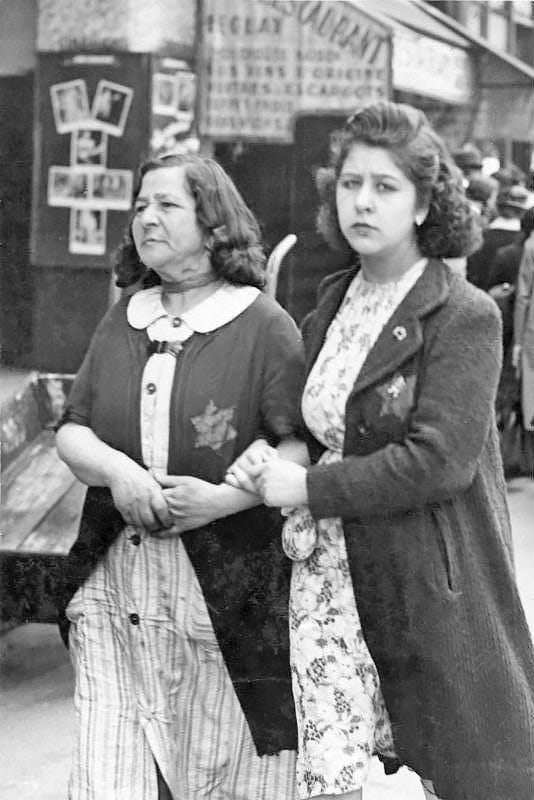
Paris, Jewish women wearing the yellow star, 1942. Bundesarchiv, Bild 183-N0619-506, CC BY-SA 3.0 DE, via Wikimedia Commons.
In July 1938, before any of this, thirty-two countries had met at Évian-les-Bains in France to discuss the refugee crisis that was already visible. Only the Dominican Republic offered to raise its quota. The other thirty-one declined, with varying degrees of regret. In April 1943, with the death camps in full operation and the deportation trains running daily, the United States and Britain met again at the Bermuda Conference and concluded that nothing additional could be done. The Vrba-Wetzler report, which two escapees from Auschwitz delivered to the Allies in 1944, described the killing process in detail. The Allies did not bomb the rail lines to Auschwitz, on the argument that doing so would divert resources from the main war effort.
In Iraq, where Jews had lived since the Babylonian exile of the sixth century before the common era, the Farhud pogrom of June 1-2, 1941 — encouraged by pro-Axis Iraqi officials and inspired by anti-Jewish radio broadcasts from Berlin in Arabic — killed approximately 175 to 600 Jews in Baghdad and wounded around a thousand more. The Mufti of Jerusalem, Amin al-Husseini, was in Berlin at the time, helping recruit Bosnian Muslims for the Waffen-SS Handschar division. The British army was eight miles outside Baghdad and did not enter the city for several days. The community in Baghdad in the early 1940s was approximately a quarter of the population — over 90,000 Jews in a city of 350,000, with Jewish family names on banks, hospitals, and opera houses. They had been there for 2,500 years.
By 1945, when the camps are liberated, what is left of European Jewry is something between a third and half of what was there before. The pre-war Polish Jewish community of 3.3 million is reduced to roughly 300,000. The German Jewish community is essentially gone. The shtetl is gone. Yiddish, which had been the daily language of approximately 11 million people, will never recover.
The survivors do not, on the whole, want to remain in Europe. Many of them try to return to their villages and find their houses occupied by neighbors who fought, in some cases, to keep them. The Kielce pogrom of July 1946 — in which Polish civilians killed 42 returning Jewish survivors — is one event of many that confirms the lesson: there is no going home. Of the survivors who can leave, a plurality go to Palestine. By 1947, the Jewish population in Palestine has reached approximately 630,000.
It is at this point that the international community decides to recognize what the survivors have already concluded.
III.
On November 29, 1947, by a vote of 33 to 13 with 10 abstentions, the United Nations General Assembly approves the partition of Mandatory Palestine into a Jewish state and an Arab state, with Jerusalem under international administration. The vote is the result of an unusual coalition: the United States and the Soviet Union both vote yes. Britain, which has held the Mandate since 1920, abstains. The thirteen no votes are largely Arab and Muslim-majority states. The Jewish state — to be carved out of roughly 56 percent of the land for what was then about a third of the population, owning less than seven percent of it — is accepted by the Jewish Agency. The Arab state is rejected by the Arab Higher Committee and the surrounding Arab governments, who reject the legitimacy of any partition.
What follows over the next six months, before the formal end of the British Mandate, is a civil war that becomes an international war. Plan Dalet, adopted by the Haganah in March 1948, specifies the military objective of securing territory designated for the Jewish state — and, in operational language, of taking, destroying, or expelling villages along the lines of communication that the new state will need. The historical literature on Plan Dalet is contested. What is not contested is the result. Between November 1947 and the summer of 1949, approximately 700,000 to 750,000 Palestinian Arabs leave their homes — through expulsion, through flight in response to massacres, through panic, through orders from their own leaders, through circumstances that varied by village. Approximately 530 Arab villages are destroyed. Estimates of Palestinian deaths during the war range from 12,000 to 15,000.
This is the Nakba — al-Nakba, the catastrophe — the founding event of Palestinian political consciousness.
The most documented single massacre of the war takes place on April 9, 1948, in the village of Deir Yassin, a few kilometers west of Jerusalem. Forces of the Irgun and the Lehi, two right-wing Zionist paramilitaries, attack a village that had signed a non-aggression pact with the Haganah. At least 107 Palestinian villagers — including women, children, and the elderly — are killed. The attackers parade some of the survivors through Jerusalem on trucks before releasing them. Reports of the massacre, exaggerated for political effect by the attackers themselves to encourage further Arab flight, spread through Mandatory Palestine within days. The Haganah condemns the operation publicly while having known of the plan in advance.
Less than a year and a half earlier, on July 22, 1946, the Irgun had bombed the King David Hotel in Jerusalem, the headquarters of the British administration in Palestine. Ninety-one people were killed: 28 British, 41 Arabs, 17 Jews, and 5 others. The Irgun’s commander, who had insisted on warning calls before the explosion, was a man named Menachem Begin. Thirty-one years later, he would be elected Prime Minister of Israel. Twenty-six years after that — in 2009 — surviving Irgun veterans would place a plaque at the hotel commemorating the bombing as a legitimate act of war. The British government, which lost twenty-eight officials in the attack, formally objected.
The men who led Israel in its first three decades had been given two names. David Grün of Płońsk became David Ben-Gurion. Mieczysław Biegun of Brest-Litovsk — who was two years old when the German army took the city in August 1915, whose family spent the war years displaced in the villages of eastern Poland, who returned home to find the borderlands repeatedly stripped — became Menachem Begin. Yitzhak Yezernitsky of Ruzhany, whose father, by Shamir’s own later account, was killed by villagers he had known since childhood after escaping a deportation train — a story he repeated but never independently confirmed — and whose mother and two sisters died in the camps, became Yitzhak Shamir. Ariel Scheinerman’s parents had fled the Russian Civil War; Szymon Perski’s family had been hunted out of Wiszniewa.
The new names were not deceptions. They were declarations. Ben-Gurion pressed officials and officers in the 1950s to adopt Hebrew names as part of the construction of the sabra — the new Jew, born in the land, free of the diaspora. The diaspora name was the name of the victim. The Hebrew name was the name of the agent.
The transformation worked. It produced a state, an army, a literature, a flag. It also produced something its planners had not specifically intended: a generation of statesmen whose entire frame of reference for what a state can do under threat had been formed inside the politics of the Pale of Settlement. They had grown up where the pogrom was a known method. Their parents had survived it, or had not. They had two operational models for how a community handles existential pressure: be the village attacked at dawn, or be the village that attacks at dawn. They had chosen, with great clarity, which of the two they refused ever to be again.
Where they had learned the alternative was not a question they were often asked.
The state declared on May 14, 1948 was immediately invaded by five Arab armies. The war that followed lasted until 1949. Israel ended it with more territory than the UN partition had allocated — about 78 percent of Mandatory Palestine. The West Bank was occupied by Jordan. Gaza was occupied by Egypt. Of the Arab villages within the new Israeli boundaries, hundreds had been physically destroyed; many of those that remained had been renamed and resettled. The dispossessed Palestinians ended up in refugee camps in Gaza, in the West Bank, in Lebanon, in Syria, in Jordan. Most of them are still there, or their descendants are, three generations later. UNRWA, the UN agency created to handle the refugee crisis, was designed as a temporary body. It has been operating continuously since 1949.
“The Jewish State, once conceived, will magnetically attract our people. The very initial difficulty of finding the right plan of action will inspire enthusiasm and confidence. We shall live at last as free men on our own soil, and die peacefully in our own homes.”
— Theodor Herzl, Der Judenstaat, 1896
IV.
Israel has, on average, fought a war approximately every nine years of its existence. The list is not contested:
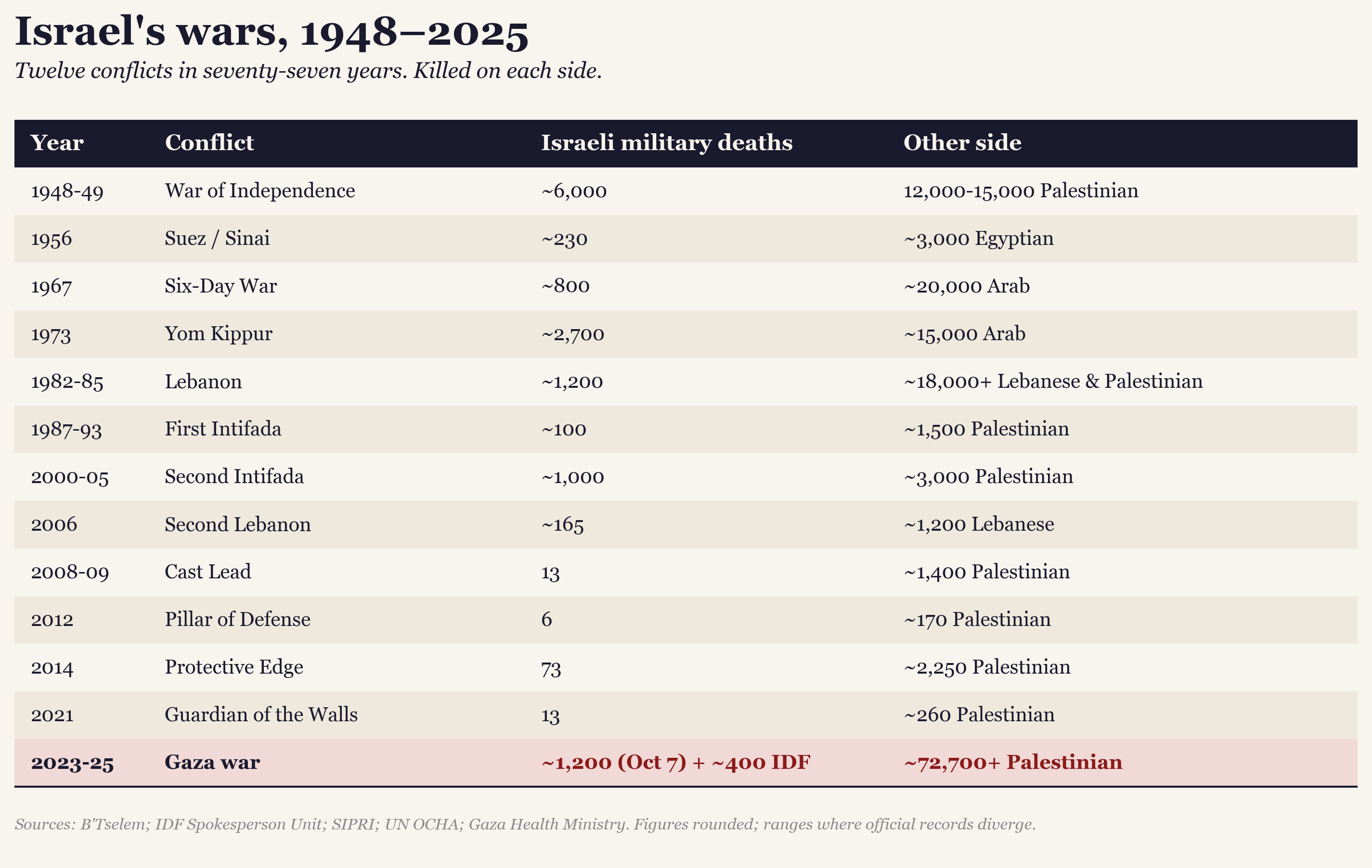
The structural feature of this list is not war frequency but war asymmetry, which has shifted over time. In the first four wars, Israel was outnumbered by combined Arab armies and was understood, by itself and by sympathetic observers, as fighting for existence. After 1967, with the Six-Day War’s territorial gains and the demonstration of Israel’s military superiority, the equation changes. By the 1980s, Israel is the regional military power. The wars it fights after that are wars against weaker opponents — Palestinian factions, Hezbollah, Hamas — on terrain that Israel substantially controls.
The state’s security doctrine, however, did not update to match the new balance. It remained calibrated to the worst case it had originally been designed against: the destruction of the Jewish community in a place where no help would come. Every threat is interpreted through that lens. Every concession is measured against the possibility of repetition.
“This colonization can, therefore, continue and develop only under the protection of a force independent of the local population — an iron wall which the native population cannot break through. This is, in toto, our policy towards the Arabs. To formulate it any other way would only be hypocrisy.”
— Vladimir Jabotinsky, The Iron Wall, 1923
Jabotinsky was the founder of Revisionist Zionism, the tradition from which Begin’s Irgun and Shamir’s Lehi emerged, and from which Likud — the dominant Israeli political force of the last fifty years — eventually descended. The Iron Wall is not a marginal text. It is, more or less, the operational doctrine that has governed Israeli security policy across both Labour and Likud governments since 1948.
In parallel, Israel constructed a nuclear deterrent. The Dimona reactor in the Negev was built starting in 1957, with French assistance from Saint-Gobain Nucléaire under contracts that the French government formally ended in 1960 but which were partially completed by then. The reactor’s existence was photographed by U.S. reconnaissance aircraft in 1960 and confronted with American diplomats. Ben-Gurion told President Kennedy it was a textile factory, then a desalination plant, then a research facility. By 1986, when the Israeli technician Mordechai Vanunu sold photographs of the inside of the Dimona facility to the Sunday Times of London — sixty photographs of an eight-story plant for separating plutonium, indicating an arsenal that Western analysts estimated at between 100 and 200 warheads — Israel’s nuclear status was an open secret that the Israeli government still officially neither confirmed nor denied. Vanunu was kidnapped by Mossad in Rome, returned to Israel via freighter, tried in camera, and sentenced to eighteen years in Ashkelon Prison, more than eleven of them in solitary confinement.
The bomb mattered because of what it implied. Israel had decided that its survival could not be entrusted to any external guarantee. Not the British Mandate, not the United Nations, not even the United States. The Trident pact of 1958 with the Shah’s Iran and Turkey — three non-Arab states in a hostile region — gave Israel a brief alliance with Tehran that lasted until 1979. Iran supplied approximately 40 percent of Israel’s oil in that period. After the Iranian Revolution, that relationship inverted into the principal regional confrontation of the next forty years.
The inversion was not immediate. The Iran-Iraq War from 1980 to 1988 — in which Israel and the United States were both, in different ways, on Iran’s side against Saddam Hussein — created strange triangulations. By the 2000s, with Iran’s nuclear program advancing and its support for Hezbollah and Hamas operational, Israeli policy had settled on a posture of preventive action: no Iranian bomb, regardless of cost.
That posture became active war in 2024 and 2025. Iran’s True Promise I, on April 13, 2024, launched approximately 300 drones and missiles at Israeli territory. True Promise II, on October 1, 2024, launched 180-200 more. Israel’s response in 2025 — the twelve-day war known internally as Operation Rising Lion, paired against Iran’s True Promise III — struck Iranian nuclear facilities and missile production sites with combined Israeli and U.S. air power. True Promise IV, in February 2026, included strikes against U.S. bases in Bahrain, Qatar, and the UAE. The regional war that had been deferred for decades happened, in compressed form, in less than two years.
V.
There are, at this point, at least two Israels.
One is the Israel that exists in the secular professional class — concentrated in Tel Aviv, in the Israeli universities and tech sector, in the human rights organizations and the protest movements, in the kibbutzim that were once the country’s ideological core. This Israel is more or less recognizable to a European or American liberal. It has gay pride parades that draw hundreds of thousands. Its publishing rate of peer-reviewed scientific papers, on a per capita basis, is among the highest in the world. It produced the drip irrigation system, the modern USB drive, the messaging protocol that became ICQ, the navigation system that became Waze, the capsule endoscope. Its army has women in combat roles. Its supreme court was, until very recently, one of the more activist in the democratic world. This Israel has been on the streets, in continuous protest, since 2023.
The other Israel is the Israel of the religious-nationalist settler movement, the Haredi rabbinic establishment, the Russian-Jewish immigrant right, the Mizrahi periphery that has resented Ashkenazi political dominance for sixty years, and the political party Religious Zionism. This Israel believes — with varying degrees of theological elaboration — that the Land of Israel belongs to the Jewish people by divine grant, that the secular state is at best a temporary administrative arrangement until messianic completion, that Palestinian national rights are categorically nonexistent, and that anyone who suggests otherwise is engaged in a form of self-hatred. This Israel is the political base that has put Benjamin Netanyahu in power, in coalition with Religious Zionism, in three of the last four governments.
The arithmetic of how these two Israels relate to each other is itself contested. Survey data suggests roughly 45 percent of Israeli Jews identify as secular, 25 percent as traditional, 13 percent as religious-Zionist, and 12 percent as Haredi (ultra-Orthodox). Birth rates within the religious populations are dramatically higher than within the secular population. Demographic projections suggest that by 2050, approximately one-third of Israeli Jews will be Haredi. The political weight of the religious-nationalist bloc is already structurally larger than its current population share, because it votes more cohesively.
The current ministers from Religious Zionism include Bezalel Smotrich — Finance Minister, settler resident of Kedumim, self-described “fascist homophobe” in a 2023 interview — and Itamar Ben-Gvir — National Security Minister, former Kach activist who kept a photograph of Baruch Goldstein on his living room wall until 2020. Goldstein, for those who do not remember, was the American-born Israeli physician who in February 1994 walked into the Cave of the Patriarchs in Hebron during Ramadan and shot 29 Muslim worshippers at dawn prayers with an IDF Galil rifle, wounding 125 more, before being beaten to death by survivors. Both Smotrich and Ben-Gvir were sanctioned in June 2025 by the United Kingdom, Australia, Canada, New Zealand, and Norway, with the Netherlands and Slovenia joining in July, for incitement against Palestinians. The Israeli government formally protested. Both remained in their cabinet positions.
In September 2025, Smotrich announced a plan to apply Israeli sovereignty — annexation — to 82 percent of the West Bank. “The principle,” he said at the press conference in Jerusalem, “is maximum land with minimum Arab population.” The Netanyahu cabinet adopted preliminary measures in February 2026 to register the land for sovereignty. Twenty-two new settlements were announced. The Jerusalem Post reported on March 29, 2026, that the plan was proceeding “in full coordination with the U.S. administration.”
“The Jews can be characterized as a Judeo-Nazi society. There is no question that we have all the features of a Nazi society. The principles of national exclusivism, of expansion through brutality, of contempt for the rights of others — all of this is now part of the daily life of the Jewish people in this country.”
— Yeshayahu Leibowitz, 1980s
Leibowitz was a Sabbath-observing Orthodox Jew, a chemistry professor at the Hebrew University, the editor of the Encyclopedia Hebraica, and one of the most respected Jewish thinkers of the twentieth century. He used the phrase repeatedly. He was not marginal in Israeli intellectual life. He was, until his death in 1994, one of its central voices. His warnings were specifically about what happens to a colonizing society’s moral fabric over time, not about any particular policy. His phrase has acquired more rather than less explanatory power in the decades since he died.
Benjamin Netanyahu, the longest-serving prime minister in Israeli history, has been on trial since November 2019 in three corruption cases. Case 1000 concerns the receipt of approximately 700,000 shekels in gifts — champagne, cigars, jewelry — from billionaire benefactors. Case 2000 concerns an alleged agreement with the publisher of Yedioth Ahronoth to weaken a competitor newspaper in exchange for more favorable coverage. Case 4000, the most serious, concerns alleged regulatory favors for the telecom company Bezeq in exchange for favorable coverage on the news site Walla. Netanyahu has attended seventy-nine court appearances as of January 2026. The trial verdict is expected in 2027. In December 2025, President Trump publicly requested that Israel’s president pardon him; the request was declined. Netanyahu remains in office. Elections are scheduled for October 27, 2026.
VI.
A state that has fought twelve wars in seventy-eight years has not survived on its own resources alone. The architecture that has sustained Israel through this period extends well beyond its borders, and the architecture itself has changed.
In the United States, the central infrastructure of Israeli political support runs through two parallel systems. The American Israel Public Affairs Committee — AIPAC — is the most professional foreign policy lobby in Washington. In the 2024 election cycle, AIPAC’s affiliated political action committees spent approximately $126.9 million on U.S. federal races, including over $100 million in Democratic primaries against incumbents who had criticized Israel’s conduct of the Gaza war. United Democracy Project, AIPAC’s super PAC, spent $9.9 million opposing Representative Jamaal Bowman in New York and $5.2 million opposing Representative Cori Bush in Missouri. Both lost. The U.S. government, under the 2016 Memorandum of Understanding, provides Israel with $3.8 billion in annual military aid — $3.3 billion in Foreign Military Financing and $500 million for missile defense — through fiscal year 2028. Supplementary appropriations since October 2023 have raised the figure substantially in each year.
The second system is less professional but larger in scale. Christians United for Israel — CUFI — was founded in 2006 by Pastor John Hagee of Cornerstone Church in San Antonio. The organization claims more than ten million members. The theological framework, dispensationalist Christian Zionism, holds that the return of Jews to the Land of Israel is a prerequisite for the Second Coming of Christ, which will be preceded by a seven-year Tribulation during which most Jews will be murdered by the Antichrist. In a 2005 sermon, Hagee argued that Hitler had been sent by God as a “hunter” to drive Jews to Israel — comments that led John McCain to reject Hagee’s endorsement during the 2008 presidential campaign. CUFI’s political weight has grown since. It now substantially exceeds AIPAC in raw membership numbers, though not in policy access.
This is the architecture that holds American political support for Israel in place: a professional Jewish lobby that punishes Democratic critics in primaries, and an evangelical Christian movement whose theological commitments make Israeli policy a matter of eschatology rather than diplomacy.
In Germany, the obligation became something close to constitutional. Chancellor Angela Merkel told the Knesset on March 18, 2008: “This historical responsibility of Germany is part of the reason of state — Staatsräson — of my country. That means that Israel’s security is never negotiable for me as German Chancellor.” The statement has been read by successive German governments as a near-categorical bar on criticism of Israeli policy. The legal architecture is real: under section 20(2) of the German Court Constitution Act, functional immunity for crimes under international law does not apply to a foreign official on German soil. If Netanyahu were to enter Germany, the law would require his arrest.
At The Hague, two parallel processes have unfolded.
The International Court of Justice has been considering South Africa’s case against Israel under the Genocide Convention since the filing on December 29, 2023. On January 26, 2024, the ICJ ruled that Israel must take provisional measures to prevent acts of genocide in Gaza, finding it “plausible” that the rights of Palestinians under the Convention were at risk. On March 28, 2024, the court ordered additional measures regarding famine conditions. On May 24, 2024, by a vote of 13 to 2, the court ordered Israel to halt its Rafah offensive. Israel has not complied with these orders. The court extended its provisional measures three times. Israel filed its counter-memorial in March 2026. Twelve other states — Belgium, Ireland, Spain, Mexico, Brazil, Colombia, Turkey, Nicaragua, Libya, Maldives, Bolivia, and Chile — have formally intervened in support of South Africa’s application.
The International Criminal Court issued arrest warrants on November 21, 2024, against Prime Minister Netanyahu, then-Defense Minister Yoav Gallant, and Hamas commander Mohammed Deif (subsequently terminated when Deif’s death was confirmed). The warrants are based on charges of war crimes and crimes against humanity, including starvation as a method of warfare. The court’s 125 member states are obligated under the Rome Statute to arrest the named individuals on their territory. Hungary refused. When Netanyahu visited Budapest in April 2025, Hungary not only declined to arrest him — it announced its withdrawal from the ICC entirely. Poland declined to enforce the warrants during the 80th anniversary of the liberation of Auschwitz-Birkenau in January 2025. Germany’s CDU government has indicated it would invite Netanyahu and find a way to prevent his arrest, despite the legal architecture pointing in the opposite direction. The institutions exist. Their enforcement is breaking down in real time.
VII.
What is happening now is the latest movement of this longer pattern.
On October 7, 2023, at 6:29 in the morning, the military wing of Hamas crossed the Gaza border fence in approximately twenty places. They killed approximately 1,200 people in Israeli communities along the border and at the Nova music festival near the kibbutz Re’im — the latter site alone accounting for 378 dead (344 civilians and 34 security personnel), according to the IDF’s final investigation. Most of the victims were civilians. Hamas killed entire families. They burned homes with people in them. They executed festival-goers fleeing the dance floor. They took 251 hostages back to Gaza, including civilians of all ages, including elderly Holocaust survivors, including children. A UN report in February 2024 and an Associated Press investigation in May 2026 confirmed that sexual violence was a central feature of the attack.
The Israeli response over the following two years killed approximately 72,700 Palestinians in Gaza, according to figures from the Gaza Health Ministry — figures that have been corroborated, in their overall magnitude, by the UN Office for the Coordination of Humanitarian Affairs, by Israeli intelligence assessments leaked to the press, and by independent academic studies. Approximately 43,000 people sustained life-changing injuries, according to the World Health Organization. More than 593 aid workers were killed, the largest single death toll for humanitarian workers in any conflict on record. Approximately 70 percent of structures in Gaza were destroyed or damaged. The population — 2.2 million people — was repeatedly displaced and forced into ever-smaller zones.
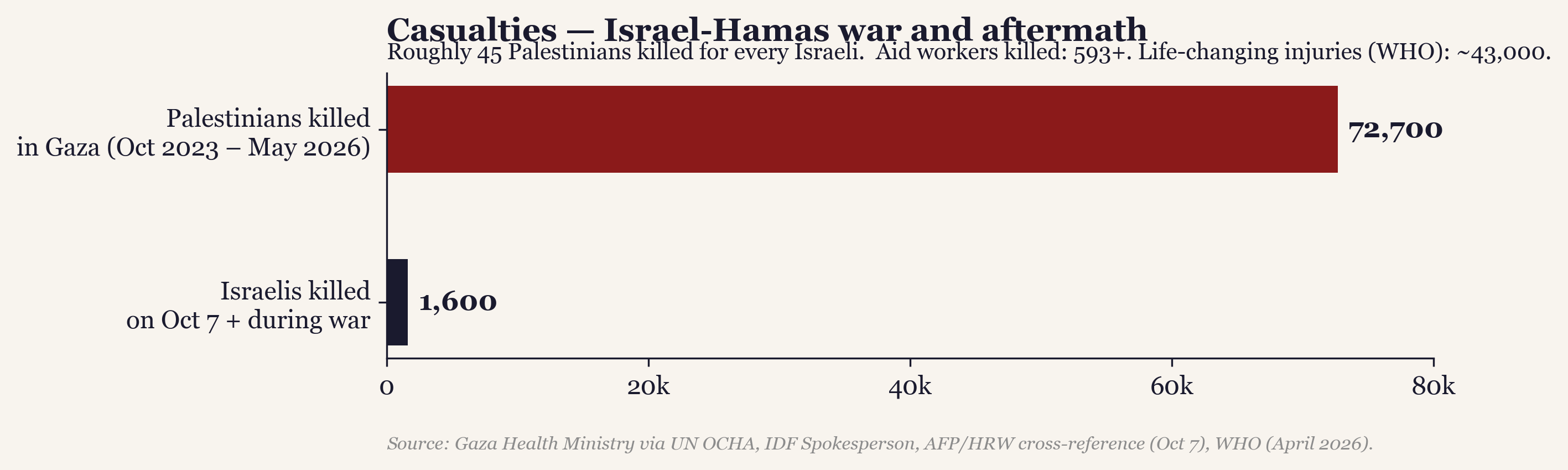
Casualties — Israel-Hamas war and aftermath, October 2023 – May 2026. Sources: Gaza Health Ministry via UN OCHA; IDF Spokesperson Unit; AFP/HRW; WHO.
On October 10, 2025, after sustained pressure from the Trump administration, a ceasefire took effect. The 20-point peace framework, mediated by Egypt, Qatar, Turkey, and the United States, brought the immediate phase of the war to an end. Hamas released the twenty surviving hostages within three days. The bodies of the deceased hostages were returned over the following months, the last in January 2026. Israel released approximately 2,000 Palestinian prisoners, 250 of them serving life sentences. The UN Security Council adopted the framework as Resolution 2803 on November 17, 2025. Since the ceasefire began, more than 700 additional Palestinians and four Israelis have been killed in cross-border incidents through April 2026.
On May 15, 2026, an Israeli airstrike on the Rimal neighborhood of Gaza City killed Izz al-Din al-Haddad, the head of Hamas’s Gaza wing — the highest-ranking Hamas leader killed since Yahya Sinwar in October 2024. Israeli officials called it the closing chapter of the war. Hamas called it a violation of the ceasefire. Both descriptions are true.
In Lebanon, the September 2024 pager attacks killed twelve and wounded thousands of Hezbollah operatives. The killing of Hassan Nasrallah on September 27, 2024 was followed by a ground invasion on October 1 and a ceasefire on November 27, 2024. After the Iranian leader Ali Khamenei was killed in March 2026, a second Hezbollah conflict followed, ending in a ten-day ceasefire in April 2026. The pattern of regional war and brief negotiated calm has become the operating rhythm.
In the West Bank, the Smotrich annexation plan is moving from announcement to administration. On February 8, 2026, the Israeli security cabinet decided to begin land registration in 82 percent of the West Bank — the territorial scope of the September 2025 plan. Twenty-two new settlements were announced. The Jordan Valley separation barrier expanded. According to UN OCHA, settler attacks on Palestinian communities increased by approximately 360 percent in the first quarter of 2026 compared to the same period in 2025. The IDF, in many documented cases, did not intervene.
“The fear of the Holocaust haunts us. We deserve the right not to be afraid. But fear cannot be the foundation of a state. A state founded on fear acts in fear. And a state that acts in fear cannot, in the end, build something worth defending.”
— Avraham Shalom, former head of Shin Bet (1980-86), in The Gatekeepers (2012)
The Gatekeepers was the Oscar-nominated documentary in which six former heads of Israel’s internal security service spoke, in direct sequence, about what their decades of operational experience had taught them. The consensus was striking. The country could not continue along the path it was on. They named the path: occupation, brutalization, the closure of any political horizon for the Palestinians, the corruption of the soul of the Israeli military. They said this in 2012. The film was screened in Israel. The political class watched it. The path continued.
Outside Israel, the consequences of all this have arrived in the form that everyone said they would not. In Sydney, on December 14, 2025 — the first night of Hanukkah — two gunmen, an Indian-Australian father and son named Sajid and Naveed Akram, opened fire at a beach gathering of approximately a thousand people. Fifteen members of the Jewish community were killed. Islamic State flags were found in the vehicle. In Washington, on May 21, 2025, a young man named Elias Rodriguez approached two staff members of the Israeli Embassy — Sarah Lynn Milgrim, 26, an American Jew from Kansas, and Yaron Lischinsky, 30, a German-Israeli, who were about to be engaged — as they left an American Jewish Committee reception at the Capital Jewish Museum. He shot them both. “Free, free Palestine,” he shouted on arrest. A grand jury indictment later cited him also yelling “I did it for Palestine, I did it for Gaza” inside the museum after the shooting.
According to the Tel Aviv University annual report on antisemitism for 2025, twenty Jews were murdered worldwide in antisemitic incidents during the year — the highest figure in more than three decades. The United Kingdom recorded approximately 3,700 antisemitic incidents. France recorded 1,320, with violent incidents rising from 106 to 126 in a single year. Canada recorded 6,800. The pattern of attacks on synagogues, on community centers, on Jewish individuals identifiable by dress or by association, has continued throughout 2026.
The wave of attacks comes from particular ideological sources. It does not come from the people in the streets of Western capitals protesting against the conduct of the war in Gaza, the great majority of whom are nonviolent and many of whom are themselves Jewish. The conflation of those two things — protest against Israeli state conduct and attacks on Jewish civilians — is one of the rhetorical maneuvers that the Israeli government uses to delegitimize criticism. But the attacks themselves are real. Jewish families in Sydney, in London, in Paris, in Los Angeles, in Washington are arranging their lives around the possibility of being shot at while celebrating a holiday. This is not propaganda. This is the lived experience of being Jewish in 2026.
It is also, in its mechanism, what Bialik was writing about in 1903.
VIII.
In a public square in Tel Aviv on a Saturday afternoon in July 2025, several thousand people are marching together against the war in Gaza and for the return of the hostages still buried somewhere under the rubble. Half of them are Jews; half of them are Palestinian citizens of Israel. The placards are in Hebrew and Arabic. The movement is called Omdim Beyachad — Standing Together — and its two national co-directors are Alon-Lee Green, a Tel Aviv-born Israeli Jew, son of a bookseller and a painter, and Rula Daood, a Palestinian citizen of Israel from the Galilee village of Kafr Yasif. The movement had approximately 7,000 paying members by December 2025. On November 27, 2025, it held its tenth-anniversary convention at the International Convention Center in Haifa.
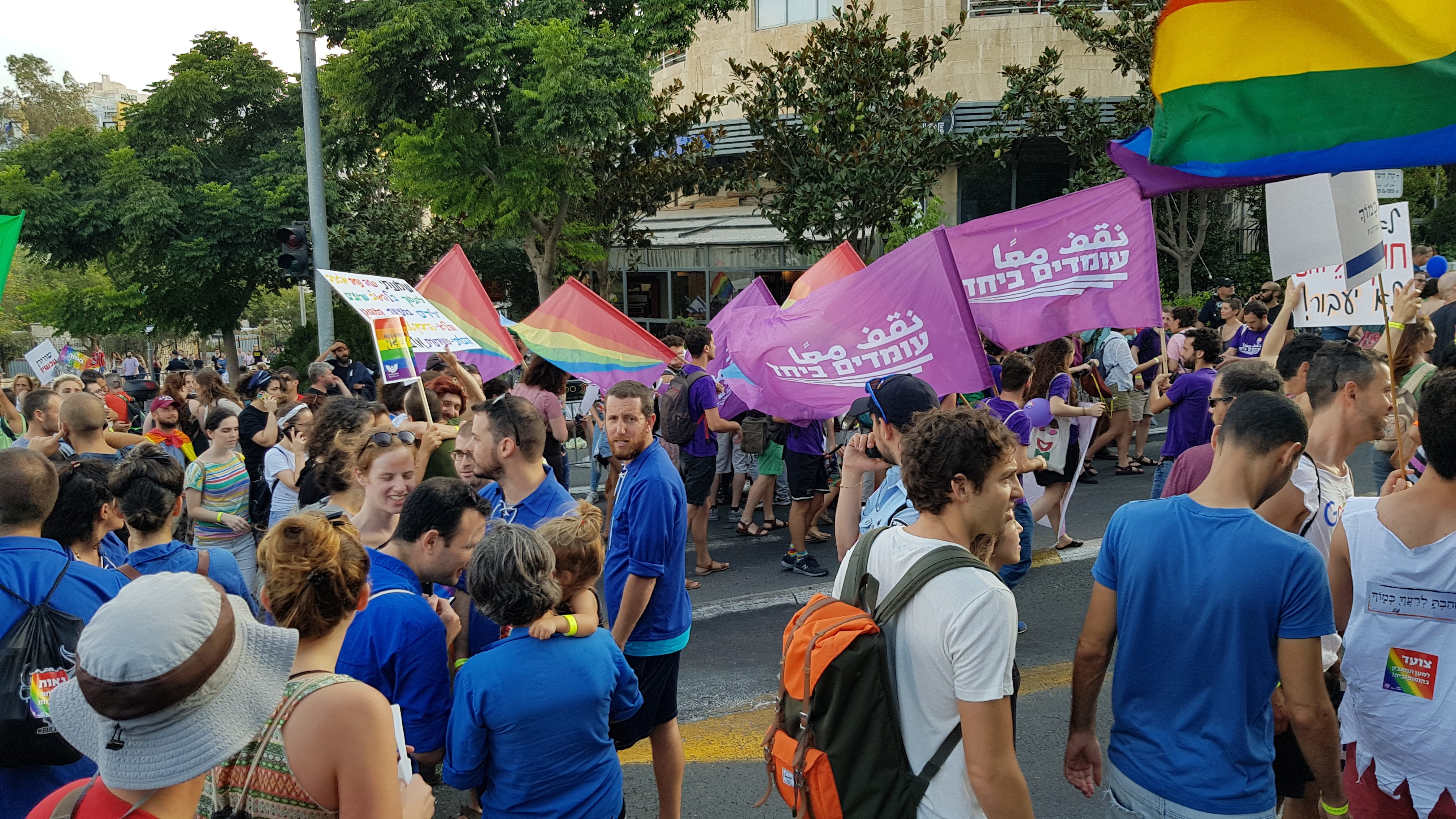
Standing Together activists at the 2018 Jerusalem Pride parade. Photo: Nettadi, CC BY-SA 4.0, via Wikimedia Commons.
Standing Together has been called a self-hating-Jew operation by Bezalel Smotrich. It has been called a normalization operation by the Palestinian BDS National Committee, which in January 2024 issued an international boycott call against it. It is denounced from the position of maximum Jewish nationalism and from the position of maximum Palestinian rejectionism for the same reason: it insists that the two populations belong to one country and have to figure out how to live in it. Members organized a “humanitarian guard” in 2024 to escort aid trucks through the West Bank past settler groups attempting to block them — a small operation that drew large amounts of attention because the underlying premise, that Jews and Palestinians might physically defend each other’s basic needs, has become unfamiliar.
It is not a peace plan. It is the lived demonstration that the people who would have to make a peace plan work are still here, on both sides, in non-trivial numbers, doing the work in the absence of one.
The work has happened before.
Baghdad, 1940. Walk down al-Rashid Street and roughly one in four of the people walking past you is Jewish. The Sassoon family — bankers, philanthropists, opera-builders — anchors commercial life. The synagogues of the Jewish quarter trace continuous worship to the sixth century before the common era. The chief rabbi is consulted by the king on matters of state. Jewish girls study for their secondary-school certificates in Arabic literature alongside Muslim and Christian classmates. Merchants in the Shorja market price spices in Judeo-Arabic and Arabic interchangeably. They share an alphabet.
This Baghdad ended in two stages. The Farhud in 1941 broke the trust. The exodus of 1950–53 emptied the community: approximately 130,000 Iraqi Jews flew to Israel via Operations Ezra and Nehemiah, leaving behind their property, their archives, their cemeteries, and a chain of memory that had run for 2,500 years. By 2003, when American forces entered Baghdad, 35 Jews remained.
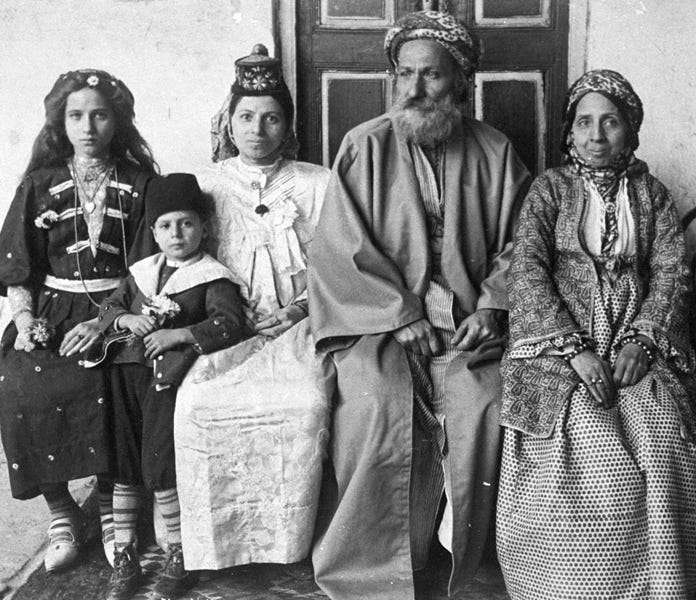
Family of Iraqi Chief Rabbi Hakham Ezra Dangoor, Baghdad, 1910. Public domain, via Wikimedia Commons.
Salonika, 1940. Greece’s second city — a Mediterranean port whose population had been majority Jewish for four centuries. The dock workers organized in Ladino. The municipal records were kept in three languages. The Jewish community numbered approximately 50,000 — the Jerusalem of the Balkans. Between March and August 1943, German occupation authorities, with the cooperation of Greek police, deported approximately 46,000 of them to Auschwitz. Around 96 percent of the Jews of Salonika were killed. The synagogues are now archives. The community is now a memorial.
Córdoba, twelfth century. One of the great cities of the medieval world, two centuries past the height of its Caliphate but still a hinge of intellectual life between Islam, Judaism, and Christianity. Born here in 1138: Moses ben Maimon — Maimonides — the rabbi-philosopher-physician who will write commentary in Arabic on Aristotle, codify Jewish law, and later serve as physician to the Sultan in Cairo, after his family is forced to flee Córdoba in 1148 by the Almohad invasion. Born here twelve years earlier: Ibn Rushd — Averroes — the Muslim jurist and philosopher whose commentary on Aristotle will be carried north by Christian translators in Toledo and change European thought. The two almost certainly never met: Averroes stayed in al-Andalus; Maimonides ended up in Egypt. But the city that produced both of them, in the same century, was not a paradise. There were riots, taxes, periodic violence. There were also several centuries of three communities living next to each other in a working society — what later writers called convivencia. The Almohad invasion ended it for Jews and Christians in stages. The Reconquista ended it permanently in 1492.
Three places. Three ends. The endings were not caused by Arabs and Jews discovering they could not live together. The endings were caused by political projects — Nazi, fascist, Catholic-monarchic, Iraqi pro-Nazi — that needed the coexistence to stop. Each one needed someone to point at the houses.
What was possible in Baghdad and Salonika and Córdoba was not utopian. It was ordinary. People shared streets and traded fairly and married late and disagreed about religion and lived. The political projects that ended it required the deliberate destruction of the structures that made ordinariness possible: civil law that treated minorities as citizens, economic interdependence that made expulsion expensive, neighborhood density that put faces on the abstraction.
Israel was built to ensure that what happened to Salonika could not happen again. The premise was reasonable. The crucial unresolved question is whether the country that exists today is preserving the conditions of Baghdad — minorities with citizenship, intermarried economies, faces attached to neighbors — or dismantling them.
Alon-Lee Green and Rula Daood are still organizing in Tel Aviv. The Knesset that sanctioned them is still legislating in Jerusalem. Sarah Lynn Milgrim and Yaron Lischinsky are buried in Washington and Modi’in. The hostages are home or buried. The bombing in Gaza has slowed and not stopped. The borders are still undefined.
Whether the next paragraph of this story is written by the people in the square or the people in the cabinet is not yet decided.
───